NATIONAL MUSEUM OF KOREA
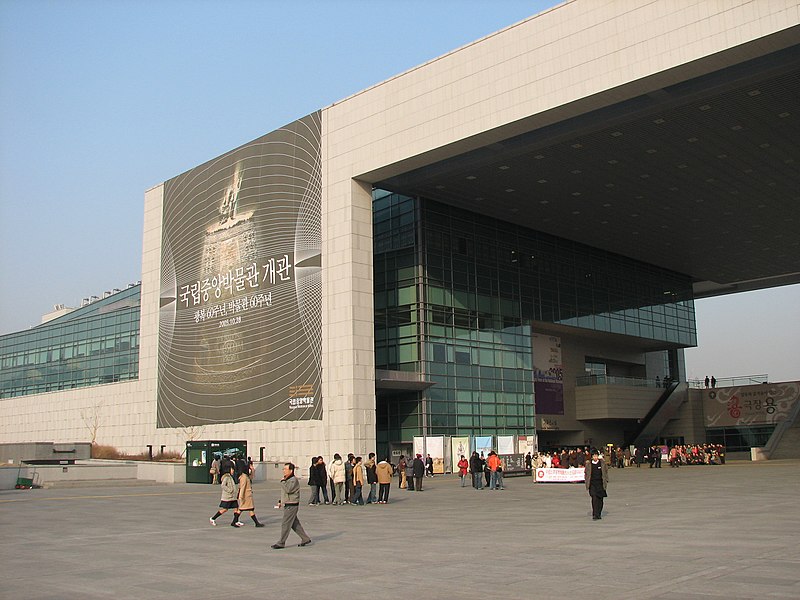 In October 2005, the museum opened in a new building in Yongsan Family Park in Seoul, South Korea. The museum sit on what used to be Yongsan golf course. The US Army return the land to the Korean government in promise that the land will remain as a park. However Korean government broke an agreement with the US Army when it was decided to build a museum. The museum contains over 220,000 pieces in its collection with about 13,000 pieces on display at one time. It displays relics and artifacts throughout six permanent exhibition galleries such as Archaeological Gallery, Historical Gallery, Fine Arts Gallery I, Donation Gallery, Fine Arts Gallery II, and Asian Art Gallery. It is the sixth largest museum in the world in terms of floor space, now covering a total of 137,201 square metres (1,480,000 sq ft).
HISTORY
Emperor Sunjong established Korea's first museum, the Imperial Household Museum, in 1908. The collections of the Imperial Household Museum at Changgyeonggung and the Japanese Government General Museum administered during Japanese rule of Korea became the nucleus of the National Museum's collection, which was established when South Korea gained independence in 1945.During the Korean War, the 20,000 of the museum's pieces were safely moved to Busan to avoid destruction. When the museum returned to Seoul after the war, it was housed at both Gyeongbokgung and Deoksugung Palace. In 1972, the museum moved again to a new building on the grounds of the Gyeonbokgung Palace. The museum was moved again in 1986 to the Jungangcheong, the former Japanese General Government Building, where it was housed (with some controversy and criticism) until the building's demolition in 1995. In December 1996, the museum was opened to the public in temporary accommodation in the renovated Social Education Hall, before officially reopening in its grand new building in Yongsan Family Park on October 28, 2005.
LAYOUT
[Exibition Hall Guide]
<< 1st floor >>
 Prehistory and Ancient History Gallery: visitors can view the unique characteristics of Korean culture based on the origin of Korea's culture and its path of each eras through characteristic relics. About 4,500 relics covering the Paleolithic to the ancient Three Kingdoms period are displayed in 9 exhibition rooms: Paleolithic Room, Neolithic Room, Bronze Age Room, Gojoseon Room, Buyeo.Samhan Room, Goguryeo Room, Baekje Room, Gaya Room, and Silla Room.
<< 2nd floor >>
 Calligraphy and Painting Gallery: This is the place to appreciate the beauty of Korean traditional and religious arts expressed with lines and color. About 890 pieces are displayed in 4 exhibition rooms. Especially, a 9-meter Buddhist painting for outdoor rituals can be viewed in the Paintings Room. Other rooms include the Calligraphy Room, Buddhist Paintings Room, and Wooden and Lacquer Crafts Room.
 Donations Gallery: Visitors can view about 800 pieces donated by contributors from their private collections. Visitors can appreciate not only Korea, but also other cultures in 11 exhibition rooms: Lee Hong-kun Collection Room, Other Collections Room, Kim Chong-hak Collection Room, Yu Kang-yul Collection Room, Park Young-sook Collection Room, Choi Young-do Collection Room, Park Byoung-rae Collection Room, Yoo Chang-jong Collection Room, Kaneko Kazushige Collection Room, Hachiuma Tadasu Collection Room, and Iuchi Isao Collection Room.
 << 3rd floor >>
Sculpture and Crafts Gallery: This is the place to appreciate the essence of Korean Buddhist sculpture and craftwork. About 630 pieces of work are displayed in 5 exhibition rooms. Especially, visitors can view the excellent Buddhist statues and the essence of Korean celadon culture including National Treasure 83, Bangasayusang (statue of sitting and thinking Buddha), which is one of the world masterpieces. Exhibition rooms include the Metal Arts Room, Celadon Room, Buncheong Ware Room, White Porcelain Room, and Buddhist Sculpture Room.
 Asia Gallery: Here visitors can understand the similarities and varieties of Asian cultures. The unique Silk Road culture, which formed with merging Eastern and Western cultures, can be viewed in the Central Asian Room. About 970 pieces of work are displayed in 5 exhibition rooms: Indian & Southeast Asian Art Room, Central Asian Art Room, Chinese Art Room, Sinan Undersea Relics Room, and Japanese Art Room.
INFORMATION
Admission:
Free to the Permanent Exhibition and the Children's Museum.
* Special exhibitions are charged separately.
Hours:
- Permanent Exhibition: Tue / Thu / Fri 9am-6pm Wed / Sat 9am-9pm Sun / holidays 9am-7pm
- Children's Museum: Tue-Sun / holidays 9am-6pm (every 1hr 30min admission, total 6 sessions, max 200 admission per session), *Last Wed of each month: 9am-9pm
*The National Museum of Korea is closed each January 1st and every Monday.
Directions:
- 150 meters towards Yongsan Family Park at Ichon Station (subway lines 4 or Jungang), exit 2, 5 minutes by walking
- Green bus 0018 / Blue bus 502 / Seoul City Tour bus: Stop on National Museum of Korea
Source : Wiki, lifeinkorea

Tidak ada komentar:
Posting Komentar