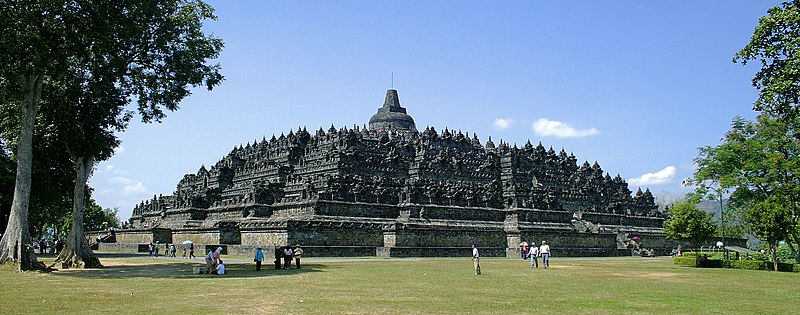
The monument is both a shrine to the Lord Buddha and a place for Buddhist pilgrimage. The journey for pilgrims begins at the base of the monument and follows a path circumambulating the monument while ascending to the top through the three levels of Buddhist cosmology, namely Kāmadhātu (the world of desire), Rupadhatu (the world of forms) and Arupadhatu (the world of formlessness). During the journey, the monument guides the pilgrims through a system of stairways and corridors with 1,460 narrative relief panels on the walls and the balustrades.
Evidence suggests Borobudur was abandoned following the 14th-century decline of Buddhist and Hindu kingdoms in Java, and the Javanese conversion to Islam. Worldwide knowledge of its existence was sparked in 1814 by Sir Thomas Stamford Raffles, then the British ruler of Java, who was advised of its location by native Indonesians. Borobudur has since been preserved through several restorations. The largest restoration project was undertaken between 1975 and 1982 by the Indonesian government and UNESCO, following which the monument was listed as a UNESCO World Heritage Site. Borobudur is still used for pilgrimage; once a year Buddhists in Indonesia celebrate Vesak at the monument, and Borobudur is Indonesia's single most visited tourist attraction.
In Indonesian, ancient temples are known as candi; thus "Borobudur Temple" is locally known as Candi Borobudur. The term candi is also used more loosely to describe any ancient structure, for example gates and bathing structures. The origins of the name Borobudur however are unclear, although the original names of most ancient Indonesian temples are no longer known. The name Borobudur was first written in Sir Thomas Raffles' book on Javan history. Raffles wrote about a monument called borobudur, but there are no older documents suggesting the same name. The only old Javanese manuscript that hints at the monument as a holy Buddhist sanctuary is Nagarakretagama, written by Mpu Prapanca in 1365.
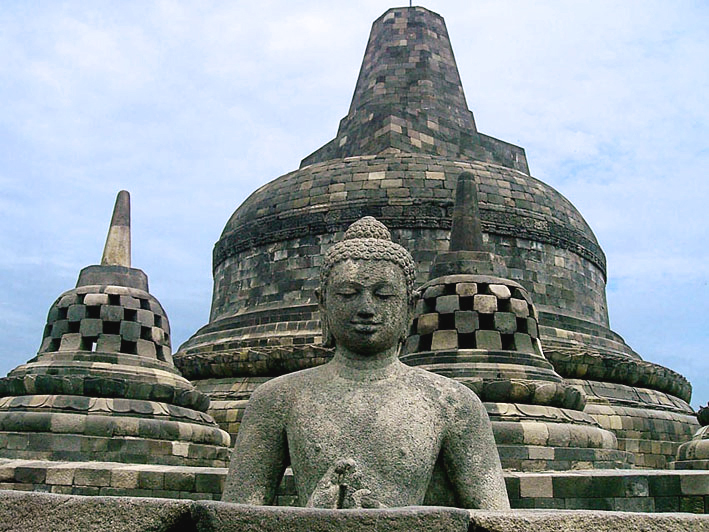 The name Bore-Budur, and thus BoroBudur, is thought to have been written by Raffles in English grammar to mean the nearby village of Bore; most candi are named after a nearby village. If it followed Javanese language, the monument should have been named 'BudurBoro'. Raffles also suggested that 'Budur' might correspond to the modern Javanese word Buda ("ancient") – i.e., "ancient Boro". However, another archaeologist suggests the second component of the name (Budur) comes from Javanese term bhudhara (mountain).
The references about the construction and inauguration of a sacred buddhist building — possibly refer to Borobudur — was mentioned in two inscriptions, both discovered in Kedu, Temanggung Regency. The Karangtengah inscription dated 824 mentioned vaguely about a sacred building named Jinalaya (the realm of those who have conquer worldly desire and reach enlightenment) inaugurated by Pramodhawardhani daughter of Samaratungga. The Tri Tepusan inscription dated 842 mentioned about the sima (tax-free) lands awarded by Çrī Kahulunnan (Pramodhawardhani) to ensure the funding and maintenance of a Kamūlān called Bhūmisambhāra. Kamūlān itself from the word mula which means 'the place of origin', a sacred building to honor the ancestors, probably the ancestors of the Sailendras. Casparis suggested that Bhūmi Sambhāra Bhudhāra which in Sanskrit means "The mountain of combined virtues of the ten stages of Boddhisattvahood", was the original name of Borobudur.


